Knowing when to stop
There is a particular kind of stuck I know well. I can always think of one more thing to improve, so the work never quite feels ready. With this project it had a specific shape: I was hesitant to run the pipeline on a whole book, or publish what came out, until it was better — and it could always be better.
This week I ran it anyway. For the first time, the pipeline translated a complete book from beginning to end: the Tao Te Ching. I set an external AI agent to watch over the run while it worked, so I could spend the day with my family instead of a progress bar — and at one point, while I was not home, the run reached a spending limit on one of the services it uses. The agent noticed, worked out that this was something only I could fix, paused the pipeline cleanly, and waited for me to get back. I was glad that it knew to stop and ask rather than push on.
It was not a clean run. The first pass took 10 hours to complete and surfaced its share of problems along the way — several bugs and a handful of chapters that had to be re-run. Only that first pass ran the whole book; after it I read what came out, investigated where it fell short, and re-ran just the chapters that needed improvement — two shorter rounds, about four and a half hours and then three, each revising against the notes from the last. Slowly the output improved, and the translations and notes came out cleaner. One chapter, 78, was particularly challenging and never came fully clean. I’ve kept notes on the specifics of the failures and what I fixed and learned for a future, more technical post.
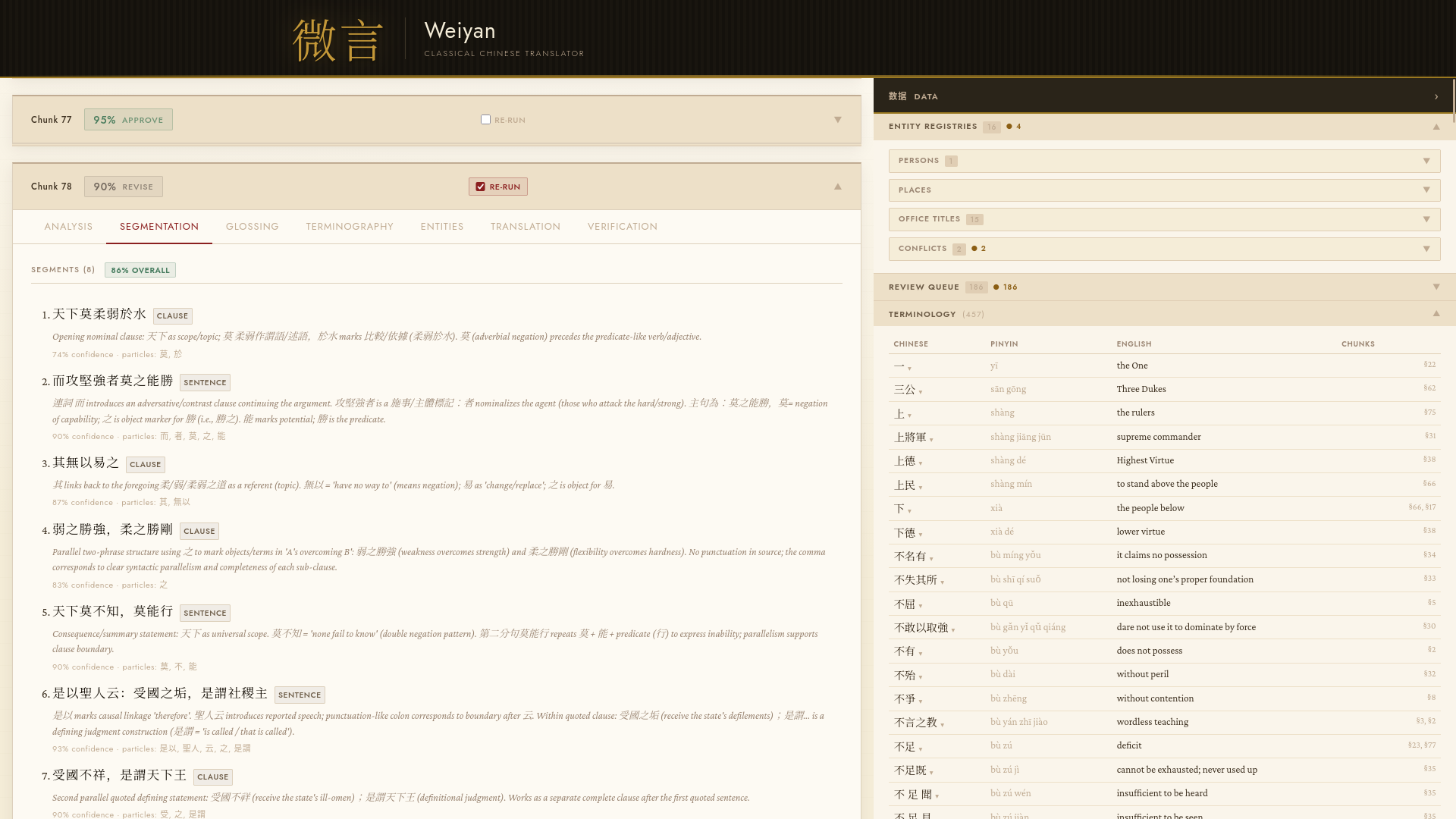
Alongside the translation I built a place to read it. By default it is just the English, one chapter to a page, moved through with a simple selector — the way you would actually want to read the Tao Te Ching. But every chapter has layers you can open when you want them: the original Chinese, a character-by-character glossary, the notes on why a line was rendered one way and not another, down to the fuller apparatus if you want to dig into it.
And still, with the text translated and the reader built, I kept finding reasons not to publish.
While the pipeline was grinding through its third round, I did something I had been meaning to do for over a week: I stopped watching it, picked up the Tao Te Ching itself, and read the next chapter in my own personal slow study of the book. It happened to be chapter 45.
大成若缺,其用不弊。 Great completion seems lacking, yet its use is never impaired.
I cannot quite explain how squarely that landed. The whole chapter is built on the idea — great fullness seems hollow, great straightness seems bent, great skill seems clumsy — that a finished thing which still looks unfinished is not failing, but working. I had been treating every remaining rough edge as a reason to push harder for perfection. Here was the book I was translating, telling me — in the line I happened to reach that morning — to call it complete without being perfect.
So it is done. The Tao Te Ching is now translated in full and published here on the site, free to read. Not as the definitive version — there isn’t one — but as one careful attempt with its workings shown, and with the rough edges I could have kept polishing forever.
Chapter 78 I left as it is. It never came fully clean, and a week ago that would have been reason enough to hold the whole book back. Leaving it be is another place I actually did what chapter 45 told me to.
The run was long; I took a lot of notes on where it could be leaner, so there is work to do in making the pipeline faster and less wasteful without losing what makes it careful. And then a second book — I haven’t settled on which, though I would like it to be something that has never been fully translated into English before. If you have a text in mind, I would be glad to hear it — send me an email at hello@weiyan.co.uk.